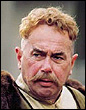
Janusz Gajos was born in
1939 in Dabrowa Gornicza. While he was working at the Puppet
Theatre in Bedzin, under its famous director Jan Dorman,
he applied to acting school four times. He graduated from
the Theatre and Film Academy in lodz in 1965 as one of its
best students.He debuted while he was still at school in
the role of Pietrek in Maria Kaniewska’s children’s film
PANIENKA Z OKIENKA (1964).
Immediate after that, Konrad Nalecki offered him the leading
role in CZTEREJ PANCERNI I PIES,
which for Gajos would turn out to be both an opportunity,
and a curse. The heroic commander of the tank "Rudy"
102, which was fighting against the Nazi invader at the
side of the "fraternal" Soviet Army, became a
genuine idol for younger audiences. Meetings with the "soldiers"
from "‘Rudy’ were organised at stadiums, schools and
cultural centres. The series’ unbelievable popularity, which
was shown numerous times on television, brought about the
blurring of the border between cinematic fiction and historical
truth. For Janusz Gajos, this mean that he was increasingly
becoming identified with the character; as a result, his
career was going nowhere. At that time, he was an actor
with the Jaracz Theatre in lodz, but the roles he appeared
in during the period were never mentioned in the reviews.
Outside of some brief appearances, he also was not acting
in films. "I was afraid that was the end. Professional
death. And I wanted very much to act, I wanted to be an
actor", he recalled.
In 1970, he moved to Warsaw,
where he worked in the following theatres: Komedia (Comedy),
Polski (Polish), Kwadrat (Square) and Dramatyczy (Dramatic).In
1977, it seemed that his problems had ended when after appearing
in Sylwester Szyszko’s film MILIONER
in the role of Jozef Mikula he received an award at the
Polish Feature Film Festival in Gdansk. "I had observed
this actor for a long time", said the director on that
occasion. "A year earlier, he appeared in my film MGLA
/ THE FOG in an episodic art as a UB [secret police]
man. And I saw that he was a different person already. I
knew that inside him there was a great actor who could break
through the [typecast]."Although one typecast may have
disappeared, there were soon new ones, connected with the
role of the custodian Turecki in the television programme
"Olga Lipinska’s Cabaret". Critics called his
character-a crafty fellow with a moustache, who wore a quilted
coat and a beret-a comedic masterpiece, and thus he was
once again pigeonholed. It was so strong that not even Gajos’s
wonderful role as the schizophrenic Michal Szmandy in Filip
Bajon’s intimate psychological drama WAHADELKO
/ SHILLY-SHALLY did not help change things, nor did
his outstanding performance in Andrzej Wajda’s CZLOWIEK
Z ZELAZA / MAN OF IRON. Critics and audiences could
only assess his role as Kapielowy in Ryszard Bugajski’s
PRZESLUCHANIE / THE INTERROGATION
years later as the result of martial law.Gajos’s long-awaited
return to the stage came thanks to Television Playhouse
(Teatr Telewizji) and Kazimierz Kutz, who cast him in the
role of Ödön von Horvath in Christopher Hampton’s TALES
OF HOLLYWOOD (Polish trans., OPOWIESCI
HOLLYWOODU) (1987). The play tells the stories of
great German authors who emigrated from Europe after Hitler
came to power, and who then found themselves in the American
"dream factory". We see their problems through
the eyes of von Horvath, who is present in every scene as
the chronicler, commentator and narrator all in one. "After
that show", said its director, "everyone was excited
about Gajos’s talent. I remember perfectly how Tadeusz Lomnicki
called me after seeing the production on television and
told me: ‘Do you know who Gajos is? Gajos is a GREEAAT actor.’
(...) I think that before that show, Janusz still was feeling
unfulfilled as an actor, a person who was a bit lost. The
stereotypes were weighing heavily upon him." ("Rzeczpospolita",
23 Sept 1999). This role really brought him enormous recognition
and liberated him. He was almost immediately inundated with
film and theatre offers, from Paul Barz’s period piece KOLACJA
NA CZTERY RECE / SUPPER FOR FOUR HANDS, in which
he played Händel, to the grotesque, such as Podsiekalnikow
in Mikolaj Erdman’s SAMOBOJCA / THE
SUICIDE (1989), or a village party secretary in Ivo
Brešan’s PRZEDSTAWIENIE HAMLETA WE
WSI GLUCHA DOLNA / ACTING HAMLET IN THE VILLAGE OF MRDUSA
DONJA (1987), to contemporary pieces such as his
role as Matyk in the film SMIERC JAK
KROMKA CHLEBA / DEATH AS A SLICE OF BREAD. "Janusz
does not have to fear being pigeonholed", said Olga
Lipinska. "He is a great actor, works hard, is talented,
and above all is constantly in search of unusual solutions.
The biggest enemy in acting is banality. Janusz is an artist
who tries to avoid banality. He can act in any genre-from
cabaret to Greek tragedy."
Gajos came to be regarded
as a multifaceted actor thanks to his role as Robert in
Marek Hlasko’s NAWROCONY W JAFFA /
CONVERT IN JAFFA, (1987), Astrov in Anton Chekhov’s
UNCLE VANYA (1989), Nos in
Stanislaw Wyspianski’s WESELE / THE
WEDDING (1995) and the monologues and sketches from
the "Pod Egida" Cabaret. "I am never worried
about whether I’m playing a writer, doctor or plumber because
I am always playing a human being", Gajos said.He also
appeared in two interesting roles in Krzysztof Kieslowski’s
films DEKALOG 4 and THREE
COLORS: WHITE."I managed to succeed despite
myself. I didn’t let myself be pushed into some corner,
which very often was a real threat. I always tried to fool
those people who wanted to be rid of me. The most important
thing is to always surprise people, which for an actor is
very interesting."The most important thing during this
period was, however, his role as the Censor in Wojciech
Marczewski’s well-known film UCIECZKA
Z KINA "WOLNOSC" / ESCAPE FROM THE "LIBERTY"
CINEMA. "The character of a censor is not very
popular with our actors. Not surprising. Even devilish horns
seem to be too noble for this colourless functionary of
falsehood. Marczewski, however, found an interesting role
for him. The censor in his film, as the co-author of a false
vision of the world, is the only person who can identify
with a reality in revolt. This is because he lives on the
edge of insanity. Janusz Gajos’s main task was to demonstrate
how someone with a trivial and cynical nature reacts to
the torturous challenge of truth. Gajos managed to carry
out this difficult task impressively, creating one of the
best roles of his acting career." (Jan Jozef Szczepanski,
"Bardzo powazny zart Marczewskiego", "Film",
no. 52/1990)Since 1985, Janusz Gajos has been one of the
stars at Warsaw’s Teatr Powszechny. His most important theatrical
roles have been there: He in Aleksander Gelman’s LAWECZKA
/ THE BENCH (1987), ("Gajos, has has grown to
be one of the leading actors of the Warsaw stage, has created
something very interesting here..." - Lucjan Kydrynski,
"Kurier Warszawski", "Przekroj", no.
2186/1987); Kochkariov in Nikolai Gogol’s THE
BRIDEGROOM (1995); Carter in Sam Shephard’s SIMPATICO
(1999); and Svidrigailov in the stage adaptation of Fyodor
Dostoevskii’s CRIME AND PUNISHMENT
(2000). "Gajos plays Svidrigailov wonderfully, delicately,
capturing all the nuances, not letting himself get carried
away, keeping his distance the whole time from both himself
and the character. How is he able to keep himself within
bounds, so as not to take one step too many, not to repeat
a gesture for better effect, not get carried away with the
words..." (Ewa Zielinska, "Koncertmistrz",
"Rzeczpospolita", no. 207/2000)He has also proven
that he feels right at home in monodramas, as well. MSZA
ZA MIASTO ARRAS / A MASS FOR ARRAS (1994), based
on the allusive novel by Andrzej Szczypiorski, remains in
Teatr Powszechny’s repertory even today. "The actor
begins the monodrama as a grey-haired old man who is weary
from life itself, who speaks with difficulty, as if he were
trying to keep the spectre of the past at bay. As he tells
this story, Jan seems to grow younger. He tells the events
in Arras as if they had just happened yesterday. Moreover-we
can see the change that they brought about in the narrator-protagonist.
He does this all by using simple and frugal techniques,
but used in a way that for the almost one and a half hours
of the play’s duration, our attention does not falter even
for a moment. He has control over the audience the entire
time. This is certainly a great achievement for an actor."
(Andrzej Z. Kowalczyk, "Ostrzezenie", "Kurier
Lubelski", no. 261, 12 Nov 1997)In recent years, Gajos
appeared frequently on the big screen as well. In the more
commercially-oriented films, he plays gangsters, cheats,
corrupt policemen and thieves. EKSTRADYCJA
/ EXTRADITION (1996); EGZEKUTOR
/ EXECUTIONER (1999); FUKS
(1999); OSTATNIA MISJA / THE LAST
MISSION (1999); TO JA, ZLODZIEJ
/ IT’S ME, THE THIEF (2000)). In art films, he plays
people with problems. He was highly praised and given an
award for his performance as an alcoholic struggling with
his addiction in Janusz Morgenstern’s film ZOLTY
SZALIK (2000). A reviewer wrote: "Janusz Gajos,
playing an alcoholic, a person who is suffering and causes
other people to suffer, has creating a character who impresses
us with his purity of expression and self-discipline."
(Krzysztof Demidowicz, "Zolty szalik", Film, no.
12/2000). Gajos’s latest success is in the title role in
the performance of BIGDA IDZIE / BIGDA
IS COMING done for Television Playhouse (Teatr Telewizji),
based on the novel by Juliusz Kaden-Bandrowski and directed
by Andrzej Wajda.
His latest
film appearance is in Andrzej Wajda’s "Revenge"
along with other stars Roman Polanski, Andrzej Seweryn,
Daniel Olbrychski. He plays one of the main characters,
Cupbearer Raptusiewicz.
Most
significant awards:
1977 - acting award
for his role in the film MILIONER / MILLIONAIRE at the POLISH
FEATURE FILM FESTIVAL in Gdansk
1981 - acting award
for his role in the film WAHADELKO / SHILLY-SHALLY at the
POLISH FEATURE FILM FESTIVAL in Gdansk
1986 - Golden Screen award for his role in the film
BING-BANG and for his outstanding acting in Television Playhouse
(Teatr Telewizji)
1986
- productions (ZAPOMNIANY DIABEL / THE FORGOTTEN
DEVIL, MGIELKA / THE MIST, PRZEDSTAWIENIE HAMLETA WE WSI
GLUCHA
1986
- DOLNA / ACTING HAMLET
IN THE VILLAGE OF MRDUSA DONJA)
1989 - the Golden
Duck (Zlota Kaczka) award for his performance in PRZESLUCHANIE
/ THE INTERROGATION
1990 - acting award
for his roles in the films PRZESLUCHANIE / THE INTERROGATION
and UCIECZKA Z KINA "WOLNOSC" / ESCAPE
1986
- FROM THE "LIBERTY" CINEMA at the POLISH
FEATURE FILM FESTIVAL in Gdansk
1992 - award for supporting
actor in the films KIEDY ROZUM SPI / WHEN REASON SLEEPS
and SZWADRON / SQUADRON
1993 - first prize for best acting at the KALISZ
THEATRICAL ENCOUNTERS for his role as Robert in Marek Hlasko’s
NAWROCONY
1986
- W JAFFA / CONVERT IN JAFFA in Poznan’s Teatr Polski
1995 - acting award
at the KALISZ THEATRICAL ENCOUNTERS for his role as Kochkariev
in Nikolai Gogol’s THE BRIDEGROOM / OZENEK
1986
- at the Teatr Powszechny in Warsaw
1996 - acting award
at the OPOLE THEATRICAL CONFRONTATIONS for his role as Nos
in Stanislaw Wyspianski’s WESELE / THE WEDDING
1986
- at Teatr Powszechny in Warsaw
1999 - award for best
supporting role in the film FUKS at the POLISH FEATURE FILM
FESTIVAL in Gdansk
2000 - special award
from Canal+ for his role in the film ZOLTY SZALIK / THE
YELLOW SCARF at the POLISH FEATURE FILM FESTIVAL in Gdansk