|
|
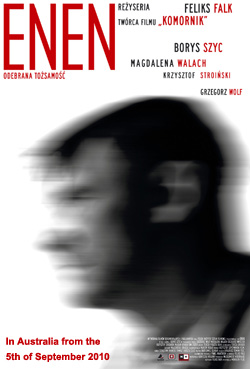
Case Unknown (original ENEN)
Director - Feliks Falk
Script: - Feliks Falk with the assistance of Agnieszka Holland)
Cinematographer - Arkadiusz Tomiak
Music - Bartlomiej Gliniak
Art Manager: Teresa Gruber
Costumes - Małgorzata Obłoza
Editing: Krzysztof Szpetmański
Producer - Włodzimierz Niderhaus
Production company - Documentary and Feature Film Production
Company (WFDiF)
Production Manager: Paweł Mantorski
Co-production - Monolith Films
Co-financing - Polish Film Institute
Distributor - Monolith Film
Cast: Borys Szyc, Grzegorz Wolf, Magdalena Walach, Ewa Ziętek,
Krzysztof Stroinski, Marian Opania, Elzbieta Karkoszka and others.
35 mm, 1:1,85, Colour, Dolby Stereo, released on 4th September 2009
100 minutes - in Polish with English Subtitles
About the film
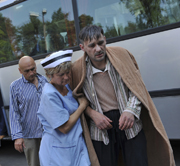
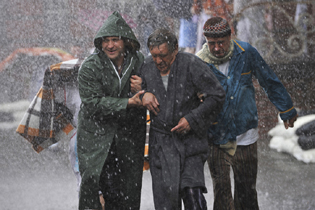
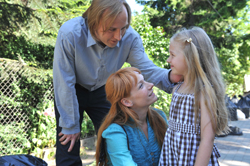
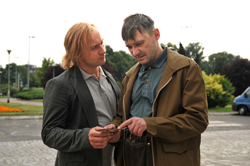
The year is 1997 and the big flood is approaching Wrocław. As a psychiatric
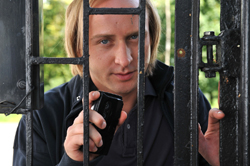
hospital is being evacuated, a young doctor Konstanty (Kostek) Gordon
comes across a mysterious patient, Paweł Płocki, whose name does not
appear in hospital files. Intrigued, Kostek tries to use a therapy
- to little enthusiasm from his superiors and colleagues. Establishing
the inmate's identity proves next to impossible, but Kostek does not
lose hope and brings the patient to his house despite the hospital
rules and his family's protest. The favourable impact of the therapy
encourages Kostek to intensify his efforts and he manages to find
the psychiatrist who accepted Płocki into the hospital twenty years
before. The psychiatrist's is evasive, but, pressed by Kostek, divulges
the horrible circumstances of that event. Has the young doctor woken
up the devil while helping the soul which got lost in the bureaucratic
machine? Feliks Falk, once a leading representative of the "cinema
of moral concern", the director of "Wodzirej / Top Dog" and "Komornik
/ The Collector" and winner of the Złote Lwy / Golden Lions Grand
Prix at the 2005 Gdynia Polish Film Festival and the Orzeł / Eagle
Polish Film Award for Directing, was inspired by a true story which
appeared in the press. However, Falk is more interested in mechanisms
than facts, and although the shocking truth discovered by the young
psychiatrist dates back to the times before the breakthrough year
of 1980, its mechanism can be set in motion nowadays, too. "Enen /
Case Unknown" is a warning against it - and more, for there a number
of references to the acclaimed "One Flew Over the Cuckoo Nest" and
its key characters: McMurphy and, even more so, Chief Bromden. Like
in Ken Kesey's novel and Milos Forman's film, it is the relationships
between the characters which are essential. Despite the thriller-like
plot, "Enen" reverberates with the echoes of the "cinema of moral
concern." The young psychiatrist does his job with genuine passion
and total devotion to his patients, and to explain the mysterious
case of Paweł Płocki he will break the law and jeopardize not only
his career but also his family life and the safety of his family.
Does he, however, realize how dangerous the game is? Who the catatonic
whom he is trying to wake up will turn out to be? And, regardless
of the circumstances which become revealed, are such great risks worth
taking? During the film's promotional campaign, Falk confided: "Some
have tried to persuade me to dot all the i's and say that if the patient's
could be woken up from his catatonic-like condition he would be a
danger to the community. Or to have Kostek, once he discovers the
truth, abandon the patient or keep him with himself, change his attitude
to psychiatry or quit the job altogether. I, however, preferred to
leave certain things unsaid. After all, a film is a conversation with
the audience and it is them that I want to have the last say. ...
The society feels uncomfortable about otherness; remember that the
communist regime abused psychiatry - take the Soviet psychiatric wards
and 'asymptomatic schizophrenia' which afflicted the dissidents. However,
it has not ended with the demise of communism. ... While the historical
context is important for structural reasons in 'Enen', its is not
crucial. To me it served as a pretext to show the moral choices which
people had to make before 1980 and the lessons which Kostek learns
about people."
Screening times:
MELBOURNE
- Sunday 5th of September 2010 at 1:00pm and 3:30pm
Only two screenings in Melbourne - Classic Cinema Elsternwick
Tickets available at Classic Cinema Elsternwick
9 Gordon Street Elsternwick - ph.
9523 9739
www.readingcinemas.com.au/cinemas/classic_elsternwick.asp
CANBERRA - Thursday 9th of September at 7:00pm
Only one screening in Canberra - National Gallery of Australia, Parkes
Place - Parkes
Tickets - at the cinema before the screening.
Telephone booking: Puma Media - ph. 03 9523 0387
SYDNEY
- Paddington - Saturday 11th of September at 5:00pm
Only one screening in Paddington at The Chauvel Cinema, cnr oxford
& Oatley Road, Paddington
Tickets - at the cinema before the screening.
Telephone booking: Puma Media - ph. 03 9523 0387
Sydney - Reading Cinema
Auburn - Sunday 12th of September at 3:00pm
Only one screening at theReading Cinema Auburn, 100 Parramatta Road,
Auburn
Tickets available at the Reading Cinema Auburn
100 Parramatta Road, Auburn - ph. 9647 0900
www.readingcinemas.com.au/cinemas/auburn.asp
PERTH - Sunday
19th of September at 3:00pm
Only one screening in Perth - Reading Cinema Belmont - cnr Knutsford
Avenue & Fulham Street, Belmont, WA 6105
Tickets available at the Reading Cinema Belmont
Cnr Knutsford Avenue &Fulham Street, Belmont - ph. 6272 9900
www.readingcinemas.com.au/cinemas/belmont.asp
ADELAIDE - Saturday 25th of September at 1:30pm
Only one screening in Adelaide -
Chelsea Cinema, 275 Kensington Rd, Kensington Park
Tickets - at the cinema before the screening.
Telephone booking: Puma Media - ph. 03 9523 0387
Director Feliks Falk |
About
the director
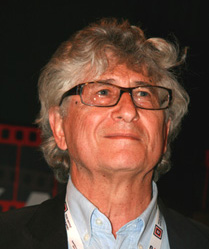
Feliks Falk, born in 1941 in Stanisławów. Film and theatre director,
writer of film scripts, stage plays, television plays, and radio
dramas; also a painter and graphic artist. A graduate of the
Academy of Fine Arts in Warsaw (1966) and the National Film,
Television and Theatre School (PWSFTviT) in Łódź, from which
he graduated in directing in 1974. He debuted as a theatre director
in 1978 with August Strindberg's "Dance of Death" at the Teatr
im. Jaracza in Łódź. His television debut was the short "Nocleg
[Overnight]" in 1973, and in 1977 he debuted on the silver screen
with "Wodzirej / Top Dog", a film whose title became a long-lasting
symbol of people's mentality in that era. Falk was an active
visual artist until the early 1980's, when he bid farewell to
that profession, though recently he has not been unwilling to
exhibit paintings created all those years ago. Among other jobs,
he worked in the monthly "Magazyn Polski" as a layout editor.
In later years, he was a lecturer at the Łódź film school. In
1991-2005, he was a film producer, co-owner of the Fokus Film
studio.
Feliks Falk has won a number of major filmmaking awards. "W
środku lata / At the Height of Summer" brought him a special
mention at the San Remo International Film Festival in 1976.
In 1986, "Bohater roku / Hero of the Year" won him the directing
award at the Polish Feature Film Festival in Gdynia, and at
the same festival in 1993, another directing award, this time
for "Samowolka / A.W.O.L.". In 1987 Feliks Falk received an
award for lifetime achievement in script writing at the Lubuski
Film Festival in Łagów. His latest success is "Komornik / The
Collector", which has won him awards in 2006 that include the
"Eagle" Polish Film Award for best director and the ecumenical
jury's award at the IFF in Berlin.
Feliks Falk's name is inseparably linked to the term "cinema
of moral anxiety", coined in the mid-1970's to designate films
that undertook the difficult task, given the political situation
at the time, of diagnosing the Polish reality. Cinema of moral
anxiety was created by young filmmakers of the day, to mention
Agnieszka Holland with her "Aktorzy prowincjonalni / Provincial
Actors", Feliks Falk and his "Top Dog", and older filmmakers
such as Krzysztof Zanussi, director of "Barwy ochronne / Camouflage".
These films, unwillingly tolerated by the authorities, were
highly appreciated by the public. Member of the European Film
Academy.
Filmography (as director; selected works): 1975: At the
Height of Summer (W środku lata); 1977: Top Dog (Wodzirej);
1979: Chance (Szansa); 1981: Był jazz (And All That Jazz); 1984:
The Idol (Idol); 1986: Hero of the Year (Bohater roku); 1989:
Capital, or How to Make Money in Poland (Kapitał, czyli jak
zrobić pieniądze w Polsce); 1991: Game Is Over (Koniec gry);
1994: Summer of Love (Lato miłości); 1995: Far from the Other
(Daleko od siebie); 2005: The Collector (Komornik); 2009: Case
Unknown (Enen); 2010: Joanna
|
|